
The Science of Synthesis Tutor 1: The Embodiment of Mathematical Knowledge


“There are times in homeschooling when you can see it click with your child. With Synthesis, I get to see that almost every time.” - Parent of Maggie and Mike
“Some concepts seem “impossibly hard” as my son doesn’t even know what the tutor is talking about, then, all of a sudden he is a total expert.” - Parent of Dax
We get hundreds of comments like this every month: Synthesis Tutor just hits in a way other programs don’t. Things just click.
This is not a fluke — it is by design. I’d like to give you a little bit of the science behind how we’ve chosen to build, and why Synthesis clicks.
How It All Begins
Making Sense of the World
When we are born we begin a lifelong process of figuring out how to navigate the world, physically and intellectually. But of course, before we do much of anything else, we have to learn how to use our bodies to engage and interact with the world around us.
The father of developmental psychology, Jean Piaget, developed a framework that describes how a typical person develops from infancy to adulthood. Roughly, the stages begin with a baby learning how to move and use her body. As she grows, she will develop symbolic, formal and abstract thought that characterize humanity’s unique intellect. This progression, from basic body movement through the higher intellect, is what we leverage to make Synthesis click.
First, a crucial word on Piaget’s first stage, what he called the sensorimotor stage. This is the stage in which a child learns to use their body in the world. As the name suggests, this set of skills depends on the tight coupling between sensory and motor systems. The child learns about her own ability to move by sensing the consequences of her movements.
Baby Steps
Getting to AHA! Moments
As any parent knows, young babies tend to flail about almost randomly. They’ll kick their legs and wave their arms in relatively uncoordinated ways for a time, progressively becoming more coordinated as they grow. But how is that coordination achieved?
A classic experimental setup can help shed light on this. In this setup, a baby is laid beneath a visually attractive mobile. A string is tied from the mobile to one of the baby’s legs. At first, the child will move her limbs in a random-ish way. By chance, she will kick her leg, which will move the mobile. That movement will catch the child’s attention. The baby will enjoy that, then go on with her random flailing.
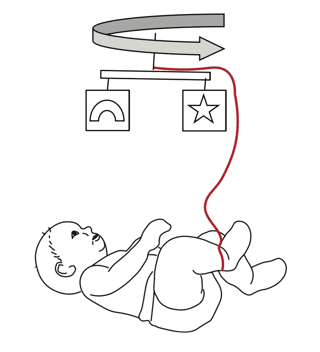
At some point, she will kick her leg again, causing the mobile to move again. The situation will go on like this, until at a crucial moment it clicks for the baby: it is the kicking of her leg that causes the mobile to move!
SHE is the cause of this effect. There is a lawful relationship between the motor action she is taking, and the sensory consequence it produces: the visual motion of the mobile.
When this AHA! Moment happens, the baby will begin kicking her leg consistently to get the mobile to keep moving.
She now understands.
When Math Education Goes Off the Rails
Failing to Connect with Intuition
As children get older they move beyond the sensorimotor stage to be able to think symbolically, abstractly, and logically — the kind of thinking we tend to associate with mathematical understanding and ability.
This is where math education goes off the rails. The problem has already snuck in.
As students learn to develop this symbolic and logical intellect, we tend to treat the earlier stages as something to leave behind.
After all, these kids aren’t babies, they can walk and talk, and much more. They are sensorimotor masters. We can now interact and educate them in purely symbolic and logical realms.
This is a MAJOR error. This is why we hear over and over: kids (and adults) don’t like math. They just don’t get it. It doesn’t click.
A New Way Forward
A Robust Path to Understanding
Here at Synthesis Tutor, we treat these stages differently. We don’t think of them as being associated with a particular age of a child, something to move past and leave behind. Instead, for each new topic learned we recapitulate these stages. We start again from the beginning, from the sensorimotor, and work up from there towards symbolic, logical, abstract.
These stages are how we learn anything and everything — regardless of age.
This is why we put so much care into the development of our digital manipulatives.
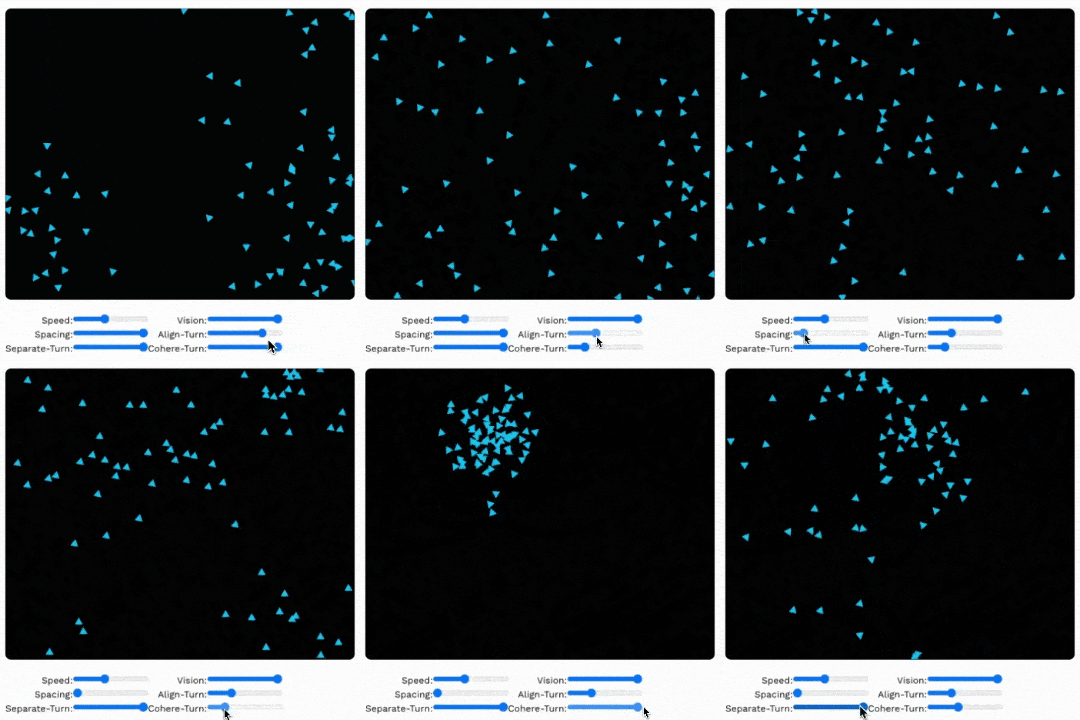
Whether our students are smashing a square with a hammer to learn about fractions, firing a blaster to learn about multiplication, exploding and fusing dots to learn about place value, or even controlling a flock of triangular critters to learn about complex systems, we always make sure to give them the opportunity for early sensorimotor AHA! Moments. Just like the baby controlling her mobile.
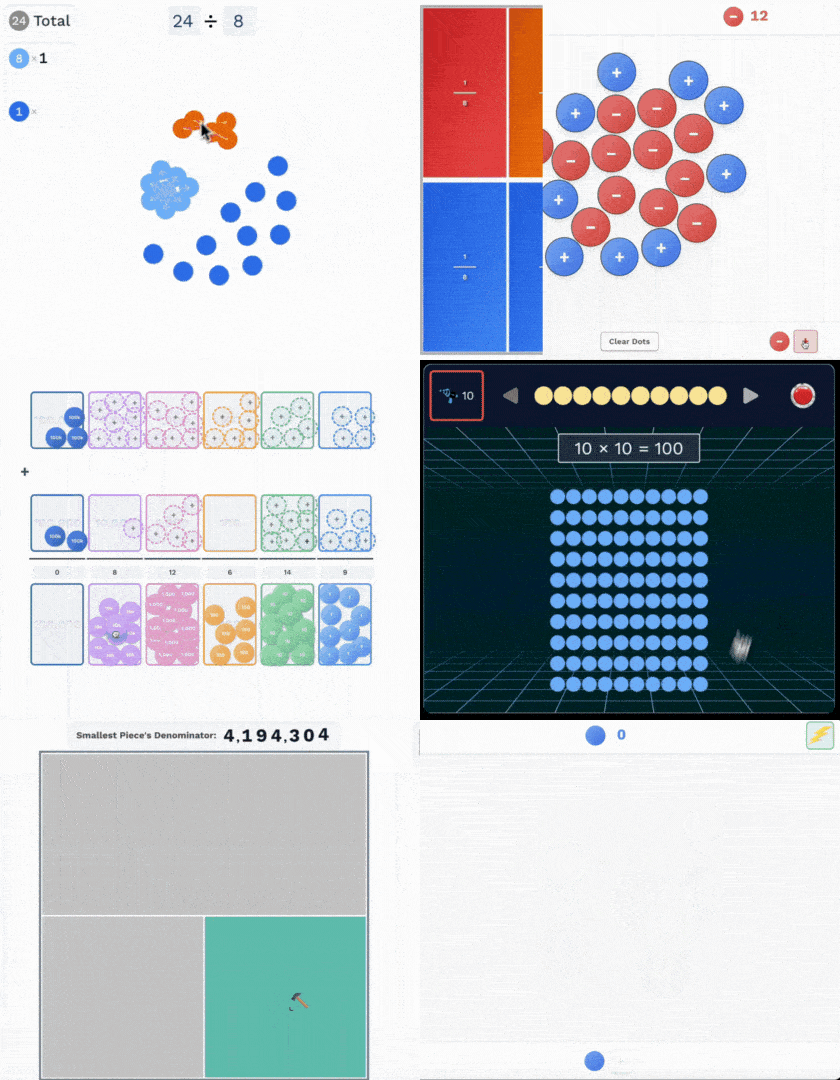
They discover the lawful causal relationships as they take action. They begin to anticipate the effect that their actions will have. They develop a deep embodied understanding of a mathematical concept.
Once this embodied understanding is achieved, we layer on the symbolic, the abstract, and the formal. But the sensorimotor foundation is what makes it click — for life.
Math That Clicks
The Opportunity
There really is no age at which learning should not begin with sensorimotor aha moments.
To that point, here is a note we received from one of our users:
“This program is amazing, I have never learned so fluidly before. I am an adult learner who unfortunately didn't get the chance to study properly when I was a kid as my parents moved around a lot and dropped out of school at an early age to work. I am now relearning properly from the beginning and using your program to study with. This program provides amazing context to connect the theoretical knowledge with, making it easy to remember.” - Juan Y
It’s a shame that math is not normally taught this way.
But it is also a huge opportunity.
We can change what math means to a generation of students, finally connecting arcane symbols back to something intuitive and embodied. A true understanding of the math they are doing. And with understanding comes enjoyment, and sometimes even love.
All best,
Joe

All posts


Synthesis Tutor is built on research by DARPA—the government agency behind GPS, the Internet, and early self-driving cars.
DARPA sought to create a digital learning system as good as the classroom, but they accidentally made something far better. In fact, their average student performed better than 99.99% of students who learned in a classroom.
But the DARPA students didn’t only outperform the classroom, they also outperformed 99.9% of Navy technicians with an average of ten years of experience. This shows us that there is a way to teach concepts—even advanced concepts—in a way that’s far more efficient and empowering.
To achieve those results, the DARPA team created software that mimicked the way experts tutored their students. Unlike human tutors, software never gets tired, frustrated, or impatient. It never has an off-day or fumbles an explanation. If a student misunderstands a concept, the digital tutor always provides just the right guidance. This, it turns out, is critical.
Most importantly, the students felt like they were learning from a real person. The tutor was digital, but it had soul. Its care, intentionality, encouragement, and patients built unbreakable trust with students. They relied upon the digital tutor, shared their struggles, and treated it like you’d treat your favorite teacher. It’s hard to believe, but the digital tutor created a bond with the students—a bond that acted like fuel for unimaginably deep, fast, and joyful learning.
To test its effectiveness, DARPA set up a competition between three groups:
- Navy technicians with an average of 10 years of experience
- Students who learned in a classroom for 36 weeks
- Students who learned with the DARPA digital tutor for 16 weeks
The DARPA students outperformed both groups by huge margins. In only 16 weeks, they were better than 99.9% of Navy technicians and 99.99% of classroom students.
No other way of learning has ever achieved anything close to these results.
If you want to get close to the DARPA results, you’ll need to hire a world-class tutor to work with your child one-on-one. But even then, research shows those students won’t perform as well as the DARPA program.
Simply put, the DARPA program is the greatest way to learn in the history of humanity. It’s a big statement—we know. But it’s inexpensive to try it and to quickly discover this for yourself.
Synthesis partnered with the team that created the original DARPA program. We expanded upon their research, tailor-made a platform for kids ages 7-10, and extended what they achieved with modern AI tools.
For the first time, any kid with an internet connection can receive the best education in the world—no matter where they are.
If you’d like to dig deeper, you can read this study conducted by the Institute for Defense Analysis.
Or check out this helpful summary of the results.